

The Role of the Regional Seats of Government (RSGs)
The RSGs were designed to ensure the continuation of central government in the aftermath of a nuclear strike. Each RSG would effectively operate as a regional government, led by a Regional Commissioner with full authority over their designated Defence Region.
Their responsibilities included:
-
Maintaining law and order
-
Coordinating emergency services and military response
-
Managing food, power, and resource distribution
-
Overseeing infrastructure repair and recovery
Unlike earlier facilities such as the War Rooms and Joint Civil-Military HQs, the RSGs had no operational role before a nuclear attack. However, once a strike occurred, they would take full control of their region for an indefinite period – until national government could be restored.
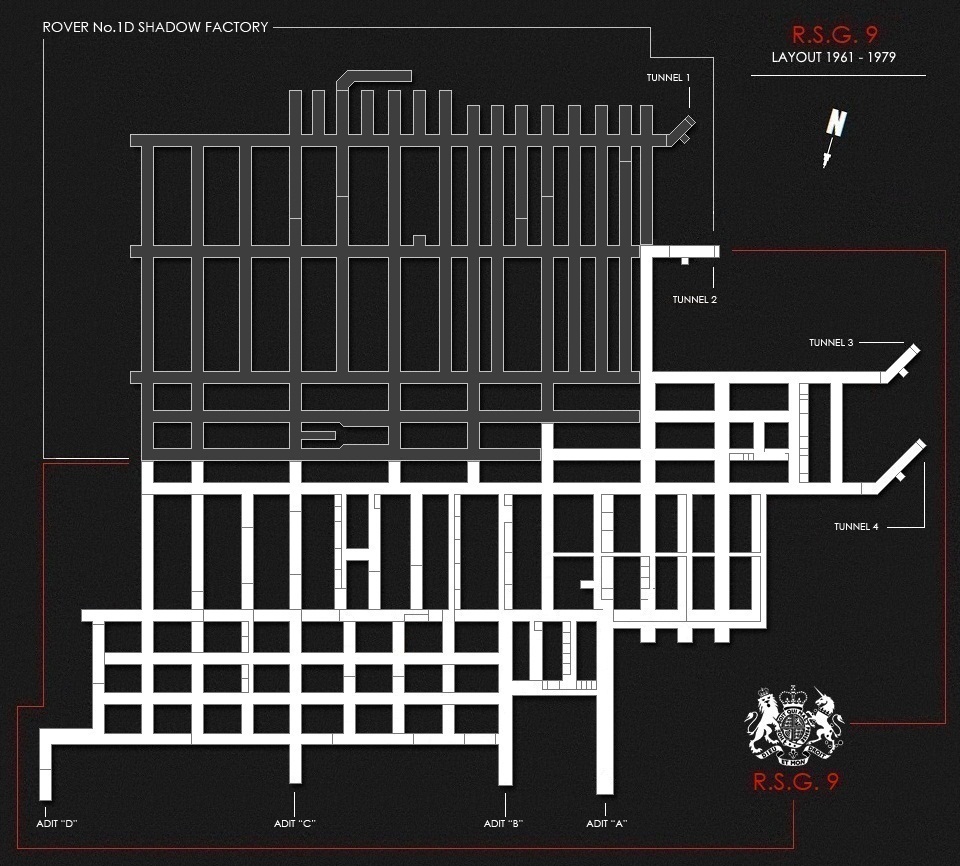
However, due to cost’s Drakelow was never reinforced or equipped with adequate protection against a Nuclear Blast, the only thing separating the RSG from the rest of the Shadow Factory was a series of purpose built brick walls. The entrances to Tunnels 1-4 were not altered, and the wooden air lock doors from WWII were left as they were. The only other conversion to take place was the installation of a water tank, and upgrading the ventilation system. The reason behind such minimal construction was: Drakelow was far enough away from a major city and thought would not be directly targeted. Construction was completed in May 1961. The cost of converting Drakelow to RSG status still remains classified, but it is thought to have been around £500,000.
R.S.G. 9 – Drakelow was activated in 1961 and covered Defence Region 9, which consisted of Shropshire, Staffordshire, West Midlands, Warwickshire, Hereford and Worcester.

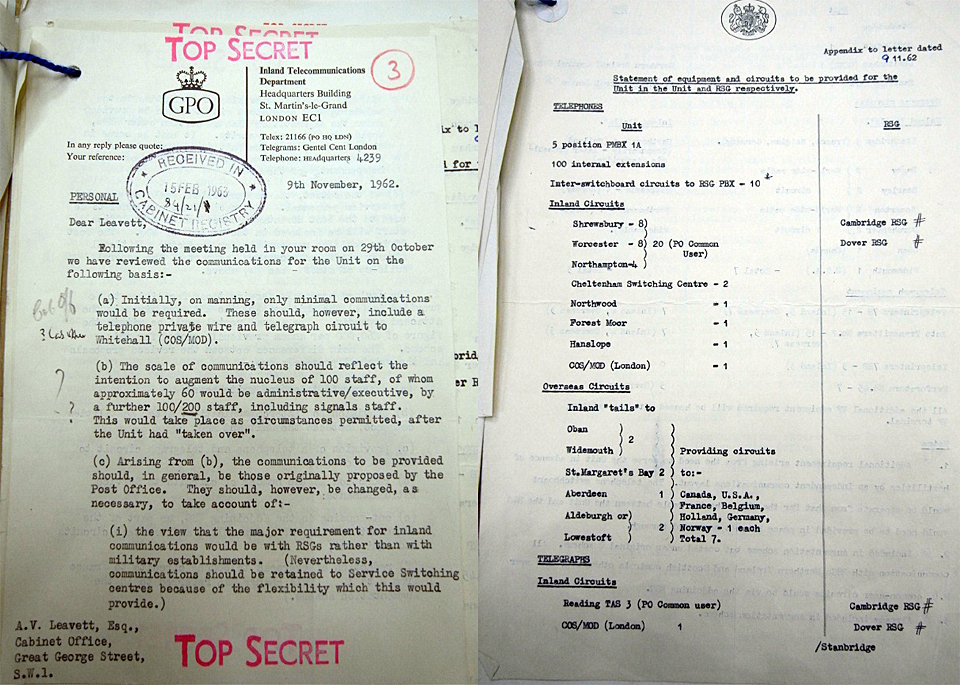
Communications for hard lines were supplied by the Post Office (GPO) and would initially consist of a Private Branch Exchange (PBX), and be operated by 3 GPO staff. This would be added to with the addition of: Intercommunication with the RSG, telephone and telegraph lines to Whitehall / MOD, 1 overseas circuit and inland circuits (Tails), and 2 world wide circuits. 15 Creed 7B Teleprinters, 15 Type 2 Auto Transmitters and 7 Type 45 Perforators would also be installed for messaging. 18KW of electricity would also be needed to power the communications. The GPO estimated that the rental of the equipment would be £60,000 a year.
In December 1964 the Prime Minister made the decision “to delay any further consideration” for the purpose built RSG’s, due to the huge costs involved. This decision was followed by a damning report from the Ministry of Defence, stating that the Regional Commissioners and the nationwide evacuation of the population could not be carried out in time, if Nuclear War was declared. The same year the RSG’s were redesignated as Sub Regional Headquarters (S.R.H.Q.).
In 1966 the Government reorganised the RSG structure once again, this time to: Sub Regional Controls (S.R.C.). This title stayed until 1971 when once again the name reverted to S.R.H.Q. this remained in place until 1979.
RSG 9 – Drakelow was officially deactivated in 1979 and placed under Care & Maintenance.